Deducting Camera Gear on 2026 Taxes: Section 179, Bonus Depreciation, and Timing
How U.S. photographers can deduct camera gear for 2026: Section 179, 100% bonus depreciation, the de minimis safe harbor, the placed-in-service rule, and the records to keep.
 Dylan AndersenPublished 14 min read
In this guide
- Can photographers deduct camera gear in the year they buy it?
- How does Section 179 work for camera gear in 2026?
- Is bonus depreciation 100% for camera gear in 2026?
- What is the de minimis safe harbor for lower-cost gear?
- What does “placed in service” before December 31 mean?
- What if you also use the camera personally?
- Which records should you keep for gear you deduct?
- What should you do before December 31?
- Frequently asked questions
The short answer
For the 2026 tax year, a U.S. photography business can generally deduct qualifying camera gear in the year it is placed in service by electing Section 179 (up to $2,560,000), by taking the 100% special depreciation allowance on qualified property acquired after January 19, 2025, or by electing the de minimis safe harbor, which covers items up to $2,500 per invoice or item for a business without an applicable financial statement. The gear must be ready and available for use in the business by the end of the tax year, which is December 31 for calendar-year taxpayers. This is general information, not tax advice, so confirm it with your accountant.
Can photographers deduct camera gear in the year they buy it?
Often, yes, if photography is a business and the gear is used in it. Equipment that lasts more than a year is normally depreciated, which means its cost is deducted over several years. Federal tax law gives businesses three ways to take the deduction sooner, and each has its own conditions. The rules below apply to the 2026 tax year and come from IRS sources, linked where each figure appears. IRS Publication 946 is the main reference for all of them.
The three routes can overlap on the same purchase, and the best choice depends on your income, your entity type, your state, and what you plan to buy next year. That choice belongs to you and your accountant. What you control today is the timing and the records.
| Route | What it does | Figure for the 2026 tax year |
|---|---|---|
| Section 179 election | Deducts the business cost of qualifying gear in the year it is placed in service | $2,560,000 maximum, reduced once Section 179 property placed in service in the year passes $4,090,000 |
| Bonus depreciation | Deducts a set percentage of the cost in the first year, before regular depreciation | 100% for qualified property acquired and placed in service after January 19, 2025 |
| De minimis safe harbor | Expenses lower-cost items instead of capitalizing them | $2,500 per invoice or item without an applicable financial statement, $5,000 with one |
| Regular depreciation | Deducts the cost over the property's recovery period | Set by the class and convention rules in IRS Publication 946 |
How does Section 179 work for camera gear in 2026?
Section 179 lets a business elect to deduct the cost of qualifying property in the year it is placed in service. For tax years beginning in 2026, Revenue Procedure 2025-32 sets the maximum deduction at $2,560,000 and begins reducing it once the cost of Section 179 property placed in service during the year exceeds $4,090,000. Those are the inflation-adjusted versions of the $2,500,000 and $4,000,000 amounts written into 26 U.S.C. § 179 in 2025.
Few photographers will come near that ceiling. The conditions underneath it are the part that decides whether a camera qualifies, and Publication 946 spells them out.
- Bought for the business
- The property must be acquired by purchase for use in your trade or business. Gifts and inherited gear do not qualify.
- More than 50% business use
- You can elect Section 179 only if you use the item more than 50% for business.
- Business share only
- With mixed use, you multiply the cost by the business-use percentage and deduct from that figure.
- Capped by business income
- The deduction is limited to taxable income from the active conduct of a trade or business. An amount you cannot use carries to the next year.
- Elected on Form 4562
- You make the election on Form 4562, filed with the return for the year the gear was placed in service.
- Can be recaptured
- If business use falls to 50% or less during the recovery period, you may have to add part of the deduction back to income.
Is bonus depreciation 100% for camera gear in 2026?
For most gear bought recently, yes. The IRS calls bonus depreciation the special depreciation allowance. Legislation enacted in July 2025 (Public Law 119-21) made a 100% allowance permanent for qualified property acquired after January 19, 2025, and the IRS confirmed the rule in its January 2026 guidance, Notice 2026-11. A camera or lens you buy and put to work in 2026 was acquired well after that date.
Publication 946 says qualified property includes tangible property depreciated under MACRS with a recovery period of 20 years or less, and that it can be new property or certain used property. The allowance applies unless you elect out of it for a class of property, an election your accountant can make on the return.
Gear acquired on or before January 19, 2025 follows an older schedule with lower percentages. If you are only now placing older purchases in service, ask your accountant which percentage applies and check the current edition of Publication 946 instead of assuming 100%.
What is the de minimis safe harbor for lower-cost gear?
The de minimis safe harbor lets a business expense smaller purchases outright instead of tracking them as depreciable assets. The IRS's tangible property regulations page gives the thresholds: up to $2,500 per invoice or item if you do not have an applicable financial statement, and up to $5,000 if you do. An applicable financial statement is, broadly, a certified audited statement or one filed with a regulator, so a photographer without one uses the $2,500 figure. That threshold has applied since tax years beginning on or after January 1, 2016.
The amount is tested per invoice or per item as substantiated by the invoice. That is a practical reason to ask for an itemized invoice when you buy a bundle, so the price of each piece is on paper. The IRS also says the thresholds are not a ceiling on what you can deduct. Costlier gear simply falls outside the safe harbor and goes through the regular rules, including Section 179 and bonus depreciation.
- 01
Have a consistent practice
You must expense these amounts on your books under an accounting procedure that existed at the start of the tax year. Without an applicable financial statement it does not have to be written. - 02
Elect it every year
The election is annual. It is not a permanent change of accounting method. - 03
Attach the statement
The statement is titled “Section 1.263(a)-1(f) de minimis safe harbor election” and goes with your timely filed original return, including extensions. - 04
Apply it to everything that qualifies
Once elected for the year, it covers all expenditures that meet the criteria, not a hand-picked few.
What does “placed in service” before December 31 mean?
The year you take the deduction is the year the gear is placed in service, and Publication 946 defines that as the point when property is “ready and available for a specific use.” The order date and the charge on your card are not the test. A lens ordered on December 29 that arrives on January 4 was not available for work in December.
Publication 946 gives two examples that mark the boundaries. A machine delivered one year but not installed and working until the next is placed in service in the later year. Property that is ready to use counts as placed in service even if you have not used it yet. For a calendar-year taxpayer, the 2026 deadline is Thursday, December 31, 2026. If your business uses a fiscal year, its last day is your deadline.
Gear you already owned personally and start using for the business is treated as placed in service on the date of that change. Write the date down and ask your accountant how the item should be valued.
Year-end timing matters in one more way if you depreciate gear over several years instead of expensing it. Under Publication 946, when more than 40% of the depreciable basis of the MACRS property you placed in service during the year went into service in the last three months, the mid-quarter convention applies, and property placed in service in the final quarter gets one and a half months of depreciation for that year. Amounts expensed under Section 179 are left out of that test, which is one more thing for your accountant to weigh.
| Situation | Placed in service in 2026? | What to record |
|---|---|---|
| Delivered, unboxed, tested, and in your kit by December 31 | Yes, for a calendar-year business | Delivery date and the date it was ready to work |
| Ordered and paid in December, delivered in January | No. It was not available in 2026 | Order date and actual delivery date |
| Delivered in December, missing a part it needs to function | Not until it is ready for its use | The date the missing part arrived |
| Personal camera moved into the business mid-year | On the conversion date | The date and how you documented the change |
What if you also use the camera personally?
Then only the business share is deductible, and you need a number you can defend. Estimate the business-use percentage from real evidence, such as shoot dates, client jobs, and how often the item leaves the house for personal trips, and record how you arrived at it. Section 179 is off the table for an item used 50% or less for business.
Cameras also appear in the tax code's list of “listed property.” Publication 946 includes photographic and video recording equipment in the category of property generally used for entertainment, recreation, or amusement. The regulation behind that list carves out an exception for equipment used exclusively at your regular business establishment or in connection with your principal trade or business. The Form 4562 instructions describe the same exception.
Where an item is listed property, Publication 946 requires it to be used more than 50% for qualified business use to qualify for Section 179, and otherwise it is depreciated by the straight-line method over the alternative (ADS) recovery period. You also have to prove the business use with adequate records: the amount, the date, and the business purpose of each use. If photography is a side business next to another job, ask your accountant whether the exception applies to you.
Which records should you keep for gear you deduct?
The IRS says records for business assets should show when and how you acquired the item, the purchase price, any Section 179 deduction and depreciation taken, how you used it, and when and how you disposed of it, with the selling price. Purchase and sales invoices and proof of payment are the documents it names.
Keep them longer than you might expect. IRS guidance on how long to keep records says to hold property records until the period of limitations expires for the year you dispose of the property. For a lens you keep eight years, that means the purchase receipt outlives the lens.
Selling is a tax event too. Under IRS Publication 544, gain on the sale of depreciable personal property is treated as ordinary income up to the depreciation allowed or allowable, and both the Section 179 deduction and the special allowance count as depreciation for that purpose. If you fully deducted a body and later sell it used, your accountant needs the sale price and date.
| Record | What it supports | Keep it with |
|---|---|---|
| Itemized invoice and proof of payment | Cost, purchase date, and the per-item price | The item record |
| Delivery and ready-to-use dates | The year the gear was placed in service | The item record |
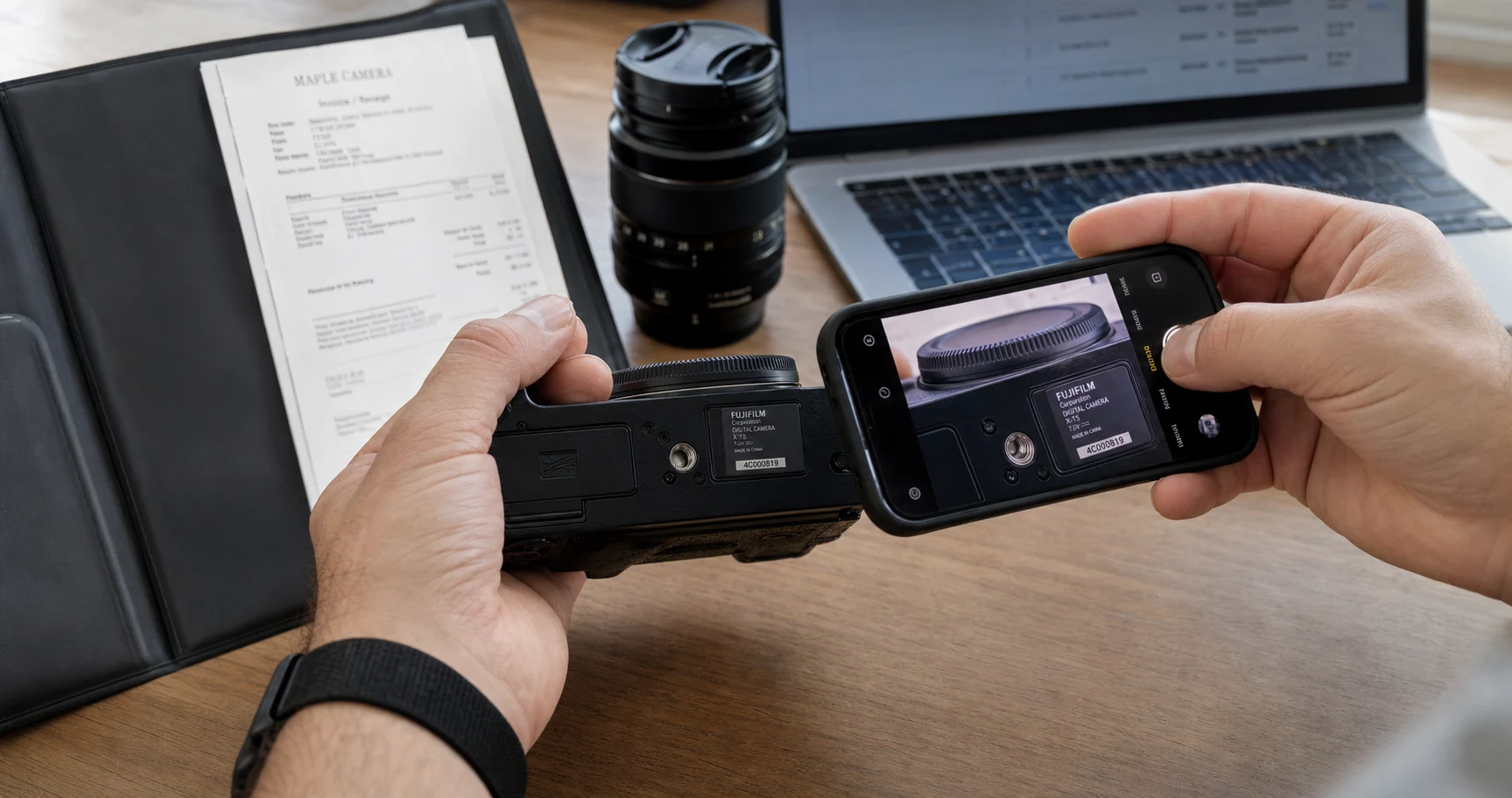
| Serial number and photos | That the deduction refers to a specific item you held | The item record |
| Business-use evidence | The percentage you claimed | Shoot plans, calendar, and client invoices |
| Deduction taken each year | Depreciation history and any recapture later | Your return and your accountant's schedule |
| Sale price, date, and costs of sale | Gain or loss when the gear leaves | The item record, marked sold |
What should you do before December 31?
Most of the work is recording facts while they are easy to prove. The day-one checklist for new camera gear covers the intake, and the year-end inventory check catches what was sold or retired during the year.
GearDex keeps the purchase date, price, seller, serial number, and receipt on each item in the gear library and documents. On Pro, Reports includes a Tax Year view that lists each item with its purchase date, cost, business-use percentage, and basis for a calendar year, and downloads as a CSV for your accountant. It is a planning estimate built on whole calendar years from the purchase date. It does not apply the conventions above, make an election, or prepare a tax form. The free camera gear depreciation calculator is different again: it models declining resale-style value and cost per shoot, not tax depreciation.
State income tax rules do not always match the federal ones, so a deduction allowed on your federal return may be figured differently on your state return. Ask about that in the same conversation.
- 01
List what you bought in 2026
Every item with its invoice, price, and seller, including small accessories. - 02
Confirm each is in service
Delivered, tested, and ready for work before your tax year ends. Record the date. - 03
Set a business-use percentage
For anything also used personally, write down the figure and the evidence behind it. - 04
Mark what you sold
Date, price received, and costs of sale for every item that left the kit this year. - 05
Time planned purchases
If you intend to buy before year end, leave room for shipping delays and testing. - 06
Send it to your accountant
Share the list and the questions early, while there is still time to act on the answers.
Frequently asked questions
Can I deduct a camera I bought on Black Friday on my 2026 return?
Generally yes, if you use it in your photography business and it was placed in service, meaning ready and available for use, before your 2026 tax year ended. For a calendar-year taxpayer that is December 31, 2026. Confirm the method and the amount with your accountant.
What is the Section 179 limit for 2026?
For tax years beginning in 2026, the maximum Section 179 deduction is $2,560,000, reduced once the cost of Section 179 property placed in service during the year exceeds $4,090,000. The figures come from IRS Revenue Procedure 2025-32.
Is bonus depreciation 100% in 2026?
For qualified property acquired and placed in service after January 19, 2025, yes. The IRS confirmed the permanent 100% special depreciation allowance in Notice 2026-11. Property acquired on or before that date follows an older schedule.
Do I have to depreciate a lens that costs less than $2,500?
Not necessarily. A business without an applicable financial statement can elect the de minimis safe harbor and expense items up to $2,500 per invoice or item, provided it meets the IRS conditions and attaches the election statement to its return for that year.
Does ordering gear before December 31 count?
No. The test is when the gear is placed in service, which IRS Publication 946 defines as ready and available for a specific use. Gear that arrives in January was not available in December.
Can I deduct gear I also use for personal photography?
Only the business share. Section 179 requires more than 50% business use, and you need records that support the percentage. Cameras can also be listed property unless an exception applies, which adds stricter recordkeeping.
Does GearDex calculate my tax deduction?
No. GearDex keeps purchase dates, prices, receipts, and serial numbers, and its Tax Year report on Pro produces planning estimates you can export. It does not make tax elections or prepare forms. Check the figures with your accountant.
Is this tax advice?
No. This article is general information about U.S. federal rules for the 2026 tax year. Your situation, entity type, and state can change the answer, so confirm it with your accountant.