Year-End Camera Gear Inventory Check Before Your Insurance Renewal
Reconcile the gear you own against the list your insurer holds: sold and new items, values, serial numbers, receipts, photos, and anything out on loan.
 Dylan AndersenPublished 11 min read
In this guide
- Why check your camera gear inventory before an insurance renewal?
- How do you reconcile what you own against the insurance schedule?
- What should you do about sold, traded, and new gear?
- Should the schedule show replacement value or what you paid?
- Which serial numbers, receipts, and photos need a second look?
- How do you account for loaned, rented, and off-site gear?
- What should you send your insurer or broker?
- Frequently asked questions
The short answer
Before an insurance renewal, compare the gear you can physically account for against the schedule your insurer holds. Remove what you sold, add what you bought, correct serial numbers, and review each value against the valuation method in your policy. Then confirm receipts and photos exist for the items that matter most, note anything on loan or off-site, and send the updated list with your questions to the insurer or broker.
Why check your camera gear inventory before an insurance renewal?
A kit changes all year and the schedule usually changes once. By December most working photographers have sold a body, bought two lenses, retired a light, and lent a tripod to someone who still has it. Triple-I lists policy renewal and major purchases among the events that should trigger a review of your coverage, and it advises against simply paying the renewal without looking.
An out-of-date list costs you in both directions. Gear you sold in the spring may still be counted in the total you are paying to insure. Gear you bought in the fall may not be on the list at all. Neither problem is visible until you put the two lists side by side.
The end of the year is also when the holiday purchases arrive. If you have not recorded those yet, start with the day-one checklist for new camera gear, then come back and run the full check.
How do you reconcile what you own against the insurance schedule?
Work from two documents: the schedule or declarations your insurer currently holds, and your own inventory. Ask the insurer or broker for their copy rather than trusting the one in your files. The version they hold is the one that counts.
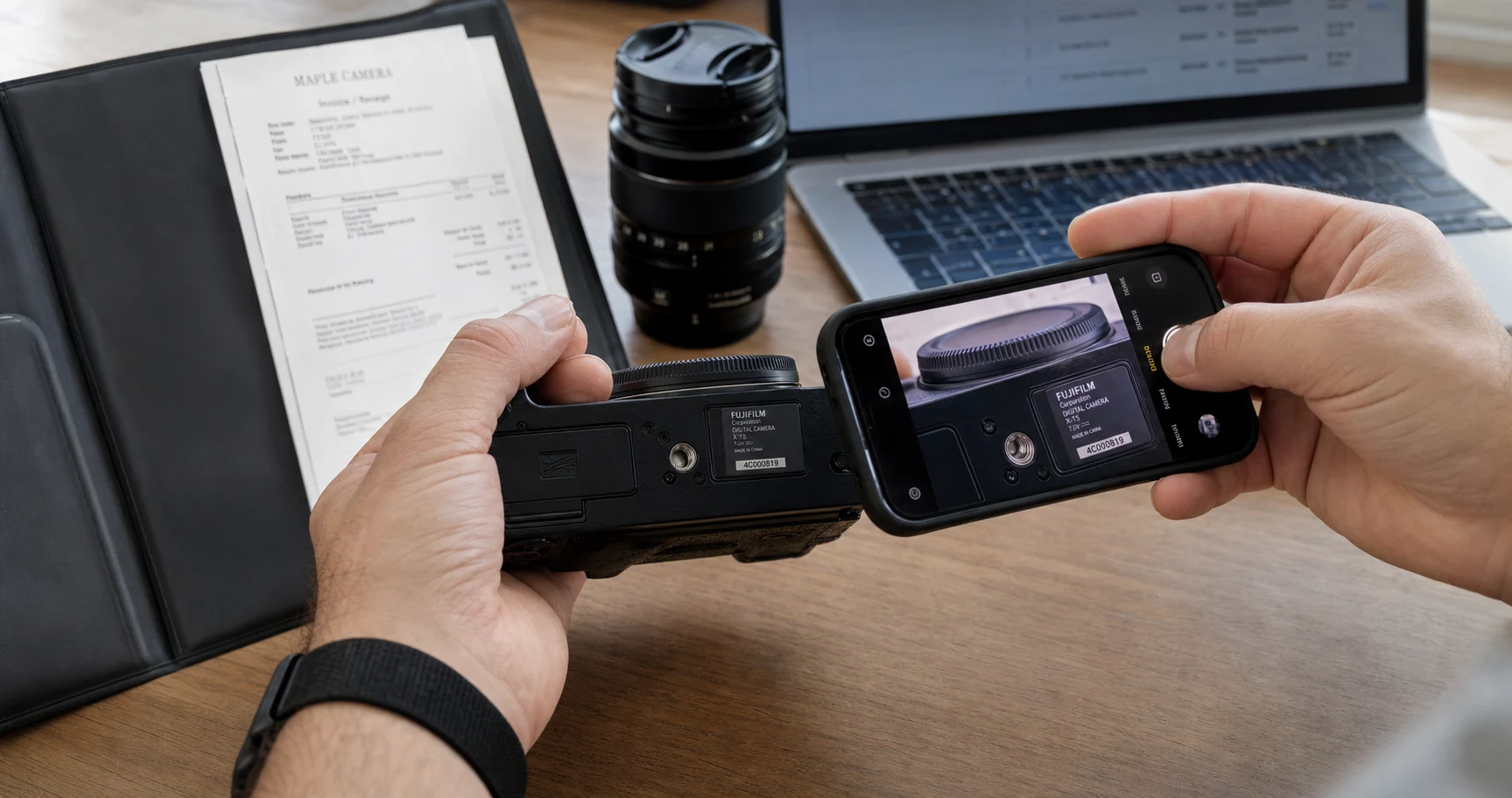
Then check the gear itself. Open every bag, case, shelf, and car trunk and confirm each item by its serial number. A list checked only against another list repeats whatever mistake both of them share.
- 01
Get the insurer's list
Request the current schedule, the policy limit, and the valuation method that applies to your equipment. - 02
Export your inventory
Pull model, serial number, purchase date, price paid, value, location, and status for every item. - 03
Touch every item
Confirm each piece is physically where the record says it is, and read the serial number from the item. - 04
Sort into four groups
Matched, owned but not listed, listed but no longer owned, and listed with a wrong detail. - 05
Fix your record first
Correct the inventory, then build the change list for the insurer from the corrected version.
| What you find | What it usually means | What to do |
|---|---|---|
| On the schedule and in your hands | The item is accounted for | Confirm the serial number and review the value |
| In your hands, not on the schedule | Bought, received, or inherited since the last update | Add the record and ask how to add it to the policy |
| On the schedule, not in your hands | Sold, traded, lost, retired, or out on loan | Find out which, then update the status or report it |
| Serial or model does not match | A typo, a swapped copy, or a warranty replacement | Correct it and tell the insurer in writing |
What should you do about sold, traded, and new gear?
Do not delete an item because it left. Mark it sold or retired and keep the date, the buyer or dealer, and what you received. The history answers later questions about when it left your possession, and the sale price belongs in your business records.
New gear needs a complete record before it goes on the list: exact model, serial number, receipt, price paid, and photos. A trade-in is two events, one item leaving and one arriving, and both should show up. If you deducted the cost of any of this gear, the same dates and prices support your tax records, which the year-end tax guide for camera gear covers.
- Sold or traded
- Record the date, the price received, and who took it. Ask the insurer to remove it.
- Bought this year
- Add the full record and ask whether it is covered now or only once it is listed.
- Replaced under warranty
- A replacement unit has a new serial number. Update the record and the schedule.
- Broken or retired
- Mark the status and decide whether it still belongs in the insured total.
- Rented or borrowed
- It is not yours to schedule. Ask separately how gear in your care is treated.
Should the schedule show replacement value or what you paid?
It should match the valuation method in your policy, so ask which one applies before you update a single number. Triple-I's guide to insuring possessions describes the two common methods. Actual cash value starts from the cost to replace the item and subtracts depreciation for age and wear. Replacement cost pays what it takes to replace the item with one of similar kind and quality, without that deduction.
The price you paid is a third number, and it is often the wrong one for either method. A lens bought used three years ago may cost more to replace today than it cost you. A body bought at launch may be worth far less. Keep all three figures on the record so you can answer whichever question the insurer asks.
Check the type of policy as well. Triple-I notes that a typical homeowners policy provides only $2,500 of coverage for business equipment. If you are paid for your work, ask in plain words whether business use of the gear is covered.
| Figure | Where it comes from | Review it when |
|---|---|---|
| Price paid | Your receipt or invoice | Never. It is a fixed fact about the purchase |
| New replacement price | A current retailer listing for the same or closest current model | Before every renewal, with the date and source noted |
| Used market value | Recent sold prices for the same model in similar condition | Before renewal, and before you sell or trade |
Which serial numbers, receipts, and photos need a second look?
Start with the items that would hurt most to lose, usually the bodies and the two or three most expensive lenses, and confirm each has a serial number read from the item, a receipt or other proof of purchase, and a clear photo. Then work down the list until the remaining gaps are items you could replace out of pocket.
Missing receipts are easier to recover now than after a loss. Search retailer accounts, email, and card statements, and record what you found and where. Do not fill a blank with a guess. The evidence checklist for cataloging camera gear covers what to gather when the original receipt is gone.
Retake photos of anything that has changed: a new dent, a replaced mount, a repaired screen. Then make sure a copy of the whole record lives somewhere other than the room the gear lives in. Triple-I's home inventory guidance makes the same point about keeping a copy outside the home.
- Serial numbers
- Read from the item, typed, and backed by a readable photo of the marking.
- Receipts
- A saved file for each high-value item, with the seller, date, model, and price.
- Photos
- The whole item, the serial number, and any damage or wear that already exists.
- Policy documents
- The current policy, schedule, and insurer contact details, stored with the records.
- A second copy
- An export or backup you can reach if the studio, laptop, or bag is gone.
How do you account for loaned, rented, and off-site gear?
Gear that is not on the shelf is where year-end checks stall. For each missing item, write down who has it, since when, and when it is due back. A lens that has been with a second shooter since June is either a loan with a return date or a loss you have not admitted yet.
Location and custody can change how a policy responds, and the details are specific to the policy. Ask about them directly instead of assuming the answer that suits you.
- Out on loan
- Borrower, date out, due date, and condition when it left. Ask whether gear in someone else's custody is covered.
- At a repair shop
- Keep the repair ticket and the date. Note the serial number in case a different unit comes back.
- In a vehicle or storage unit
- Record where it normally stays, and ask how theft from a vehicle or an unattended location is treated.
- Traveling abroad
- Ask whether the policy territory covers the countries you work in.
- Rented or borrowed from others
- Keep the rental agreement, and ask who insures equipment you do not own.
What should you send your insurer or broker?
Send the corrected list and a short set of questions in the same message, and ask for the answers in writing. Keep a dated copy of exactly what you sent. If a claim is ever made, you will want to show what the insurer was told and when.
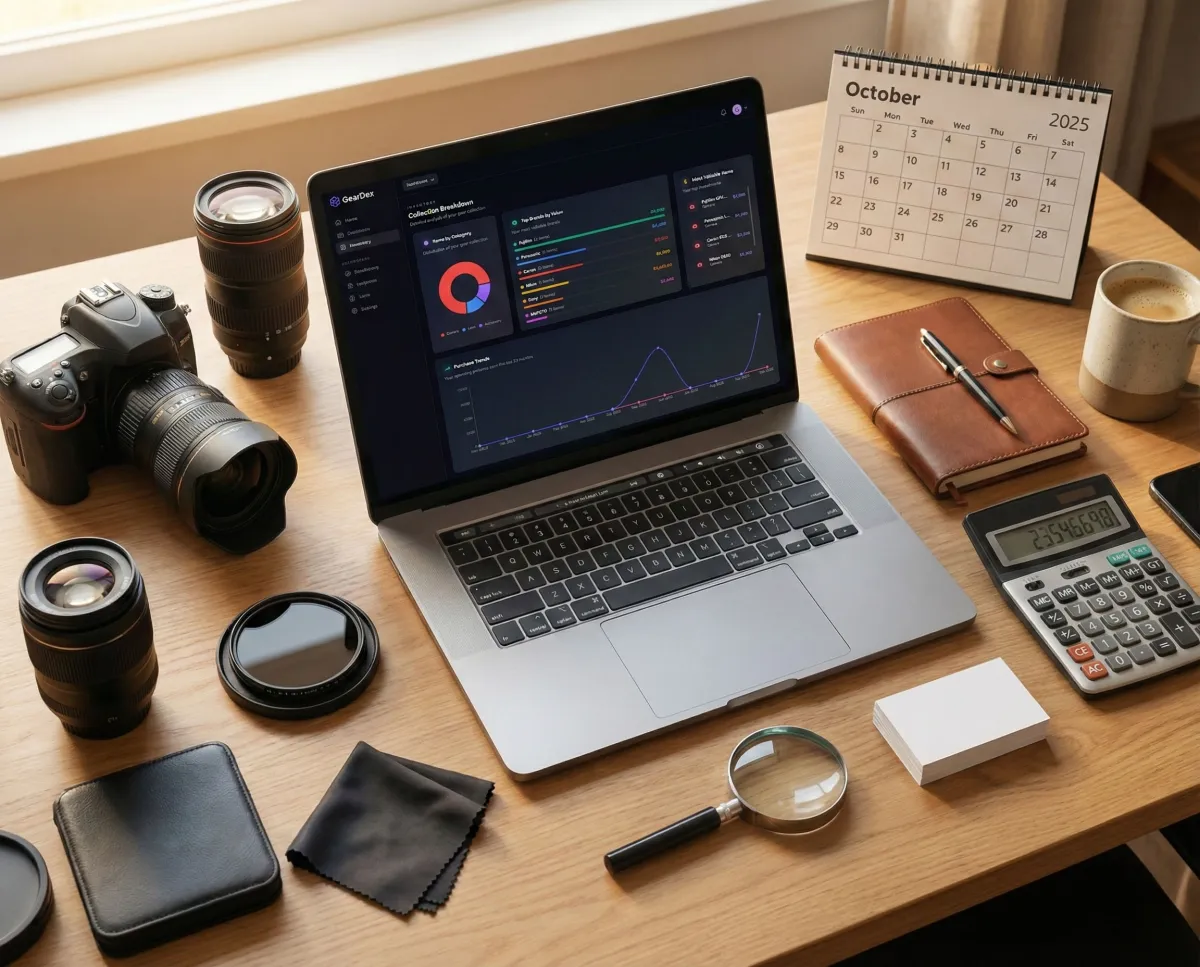
In GearDex each item carries its own value basis (new retail value, price paid, or market value), a flag for whether it is included in your insurance, and a flag for whether it is specified on the policy. Sold items drop out of the insured total. On Pro, the Insurance & Warranty report totals insured items and value, points out items still missing a value, and exports the inventory as a CSV or a dated PDF. See portfolio value and documents and warranties for how the records connect, or the page on camera gear insurance records.
Not ready for an account? The free photography equipment insurance checklist builds the question list for the way you work, and the camera gear inventory template gives you the item list as a CSV. Set a date for the next check before you close the file.
- 01
Attach the list
Model, serial number, purchase date, price paid, and the value on the basis your policy uses. - 02
Name the changes
List additions, removals, and corrections separately so nothing is missed. - 03
Ask about the limit
Compare your new total with the policy limit and ask whether any item needs to be listed individually. - 04
Ask about how you work
Paid work, travel, vehicles, loans, rentals, and drones, each as its own question. - 05
File the reply
Store the insurer's written answer and the updated schedule beside the inventory.
Frequently asked questions
How often should I check my camera gear inventory?
Update the record whenever you buy, sell, trade, or lend gear, and run a full check against your insurance schedule before each renewal. Triple-I lists policy renewal and major purchases among the events that should trigger a coverage review.
Should I insure camera gear for what I paid or what it costs to replace?
Use the valuation method in your policy. Actual cash value starts from replacement cost and subtracts depreciation, while replacement cost does not make that deduction. Ask your insurer which applies and record price paid, new replacement price, and used market value so you can answer either way.
Do I need to remove sold gear from my insurance schedule?
Tell your insurer or broker when an item leaves your possession and ask them to update the schedule. Keep the item in your own records marked as sold, with the date and price, instead of deleting it.
Does homeowners insurance cover camera gear I use for paid work?
Do not assume it does. Triple-I notes that a typical homeowners policy provides only $2,500 of coverage for business equipment. Ask your insurer whether business use is covered and what limit applies.
Is loaned camera gear still covered?
That depends on the policy. Record who has the item, when it left, and when it is due back, then ask your insurer how equipment in someone else's custody is treated.
Does GearDex provide camera gear insurance?
No. GearDex organizes the inventory, serial numbers, receipts, photos, values, and exports used in an insurance conversation. It does not sell insurance or guarantee that a claim will be covered.