Flying With Camera Gear in 2026: Carry-On, Batteries, and Customs
Pack camera gear for a flight without a battery mistake, a forced gate-check scramble, or missing proof of ownership at the border.
 Dylan AndersenPublished 11 min read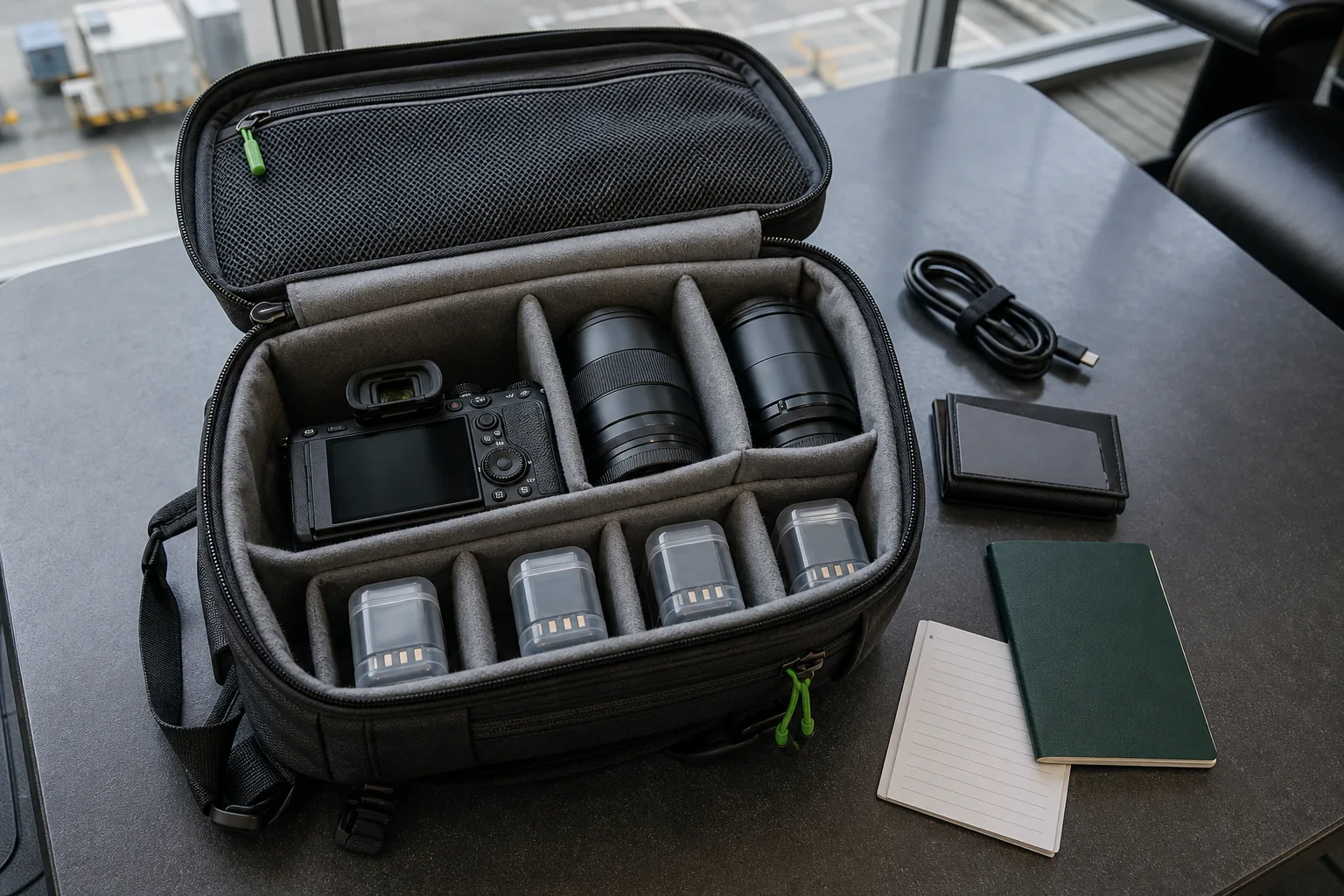
In this guide
- Should camera gear go in a carry-on or checked bag?
- How do you pack camera batteries for a flight?
- What should you do if the airline wants to gate-check the bag?
- Do you need a customs form for camera equipment?
- What belongs in a camera gear travel manifest?
- How do you turn the manifest into a packing check?
- Which rules should you check before departure?
- Frequently asked questions
The short answer
Keep cameras, lenses, memory cards, and spare lithium batteries in your carry-on whenever possible. Protect every spare battery terminal, check the airline's current size and weight rules, and keep a serial-number manifest offline. For international work, research the destination's temporary-import rules before you decide whether a U.S. CBP Form 4457 or an ATA Carnet fits the trip.
Should camera gear go in a carry-on or checked bag?
Pack the equipment that makes the shoot possible in the cabin: camera bodies, working lenses, memory cards, storage drives, essential adapters, and the smallest viable backup. A checked tripod or light stand is inconvenient when delayed. A checked camera body can end the job.
Your bag still has to fit the airline's rules. Measure the packed bag, weigh it, and check every carrier on the itinerary. A limit that worked on the long-haul flight may fail on the smaller regional connection. Keep the airline page available offline in case the answer at the gate differs from the one you planned around.
| Carry with you | Check only if necessary | Reason |
|---|---|---|
| Camera bodies and working lenses | Large support hardware | The image-making kit is harder to replace before call time |
| Memory cards and working drives | Empty hard cases | The recorded work should stay under your control |
| Spare lithium batteries and power banks | Non-battery grip and rig parts | Spare lithium batteries are not permitted in checked baggage under current U.S. rules |
| One compact backup path | Duplicate low-value accessories | A delayed bag should not cancel the shoot |
How do you pack camera batteries for a flight?
The current FAA PackSafe guidance requires spare lithium-ion and lithium-metal batteries, including power banks, to travel in carry-on baggage. Protect the terminals from short circuit with the original packaging, a fitted battery case, a sleeve, or another method that keeps exposed contacts away from metal.
Most still-camera batteries fall at or below 100 watt-hours, but read the label rather than guessing. The FAA says batteries from 101 through 160 Wh require airline approval and limits travelers to two spares in that range. Batteries above 160 Wh are not allowed in passenger baggage under the standard exception. Airlines and other countries may set stricter rules.
- 01
Read the label
Record the watt-hour rating. If only volts and amp-hours are shown, multiply V by Ah to calculate Wh. - 02
Protect the contacts
Use one secure sleeve or case per battery, or cover exposed terminals as the manufacturer and carrier permit. - 03
Separate damaged batteries
Do not travel with a swollen, damaged, defective, or recalled battery. - 04
Plan for the gate
Keep a small battery pouch ready to remove if your carry-on is taken for gate-checking. - 05
Check the carrier
Verify quantity, watt-hour, and power-bank limits with every airline on the reservation.
What should you do if the airline wants to gate-check the bag?
Decide the answer at home, not while a line forms behind you. Pack a thin foldable personal-item bag inside the camera bag. It should hold the bodies, one working lens, cards, drives, batteries, travel documents, medication, and anything else you cannot surrender. Keep that layer easy to remove without unpacking on the floor.
A polite request may keep fragile professional equipment in the cabin, but it is not a plan. Full bins, small aircraft, and local rules can still take the bag. A hard-sided shell, closed lens compartments, rain cover, tracker, and contact card reduce the damage if the rest of the kit has to go below.
Do you need a customs form for camera equipment?
U.S. travelers can use CBP Form 4457 to register personal effects taken abroad. The signed form can help show that listed equipment was in your possession before the trip when you return to the United States. Arrange verification with Customs and Border Protection before departure and bring the actual items.
Form 4457 does not grant permission to import professional equipment into another country. A personal vacation kit, a paid production, a commercial crew, and equipment that may be sold abroad can face different requirements. Check the destination's customs authority and consulate, plus every transit country that matters to the route.
For temporary professional equipment, an ATA Carnet may provide temporary duty-free admission in participating countries. It carries its own issuance, presentation, and re-export requirements. Confirm that the destination accepts it and that the planned work fits before paying for one.
| Record | What it can support | What it does not settle |
|---|---|---|
| GearDex travel manifest | A private working list of models, serials, values, photos, documents, and bag assignments | It is not a government customs form |
| CBP Form 4457 | Evidence that listed personal effects were taken abroad from the United States | The destination country's temporary-import requirements |
| ATA Carnet | Temporary import and re-export of qualifying goods in participating countries | Every permit, visa, location, drone, or work rule |
What belongs in a camera gear travel manifest?
Use exact items, not broad labels. “Telephoto lens” cannot prove which lens crossed a border, went into a rental case, or failed to come back from location. Record the full model and serial number, then photograph the item and its serial label before packing.
Keep one encrypted or access-controlled copy online and one offline copy on a device that travels with you. A camera gear insurance record and a customs manifest overlap, but neither guarantees coverage or border treatment. Verify both with the organizations that make those decisions.
- Identity
- Category, manufacturer, exact model, serial number, and a clear item photo.
- Ownership
- Purchase date, seller, receipt or invoice, country of purchase, and serial-label photo.
- Value
- Currency, stated value, source, and the date that value was checked.
- Trip role
- Carry-on compartment, checked case if applicable, shoot assignment, and backup item.
- Documents
- Insurance contact, policy reference, customs record, carnet if applicable, and emergency rental contact.
How do you turn the manifest into a packing check?
A manifest proves what you own. A packing check proves what should leave and return. Assign the exact serialized camera and lens to the trip, then add the small dependencies that can disable them: charged batteries, correct charger, cards, reader, cable, plate, adapter, hood, cap, filter, and tool.
Run the check once when the bag is packed and again before leaving the hotel or location. GearDex can hold the inventory record while the free photo shoot packing-list builder gives you an editable travel checklist without requiring an account.
- 01
Assign the working kit
Choose each body, lens, light, support item, and backup by exact record. - 02
Find single points of failure
Look for one charger, one adapter, one reader, or one cable that can stop the plan. - 03
Split the risk
Keep cards, drives, batteries, and the minimum backup path with you. - 04
Test before closing
Power every body, mount each working lens, write to each card type, and confirm chargers and readers. - 05
Check the return
Use the same list before leaving the venue, hotel, rental car, and airport.
Which rules should you check before departure?
Start with the FAA battery rules, your airline's baggage policy, the current CBP Form 4457 page, the destination's customs authority, and the U.S. Department of Commerce ATA Carnet guide for commercial equipment. Recheck them close to departure because carrier and border rules can change.
Frequently asked questions
Can camera gear go in checked luggage?
Some camera equipment can be checked, but keep the working image-making kit, memory cards, drives, and spare lithium batteries in the cabin whenever possible. Spare lithium batteries and power banks must not go in checked baggage under current U.S. rules.
Can camera batteries go in a carry-on?
Yes. Spare lithium batteries belong in carry-on baggage, with their terminals protected from short circuit. Check the watt-hour rating and the airline's current quantity and approval rules.
What happens to batteries if a carry-on is gate-checked?
Remove spare lithium batteries and power banks before the bag is taken. Keep them protected and with you in the aircraft cabin.
Do photographers need CBP Form 4457?
U.S. travelers may use Form 4457 to document personal effects taken abroad before departure. Whether it fits your trip depends on the equipment and travel. It does not replace the destination country's import rules.
When might a photographer need an ATA Carnet?
A carnet may apply when professional equipment will enter a participating country temporarily and leave again. Requirements vary by country and purpose, so confirm the current rules with official customs and carnet sources.
What should a camera travel manifest include?
Record the exact model, serial number, item photo, serial-label photo, purchase evidence, value and currency, bag assignment, insurance contact, customs record, and backup role for each item.